Wednesday, February 24, 2010

The Face of Alice

Alice Liddell, the original Alice.
The story of Alice in wonderland reportedly started as a fairy tale told to Alice Liddell by Charles Dodgsen (aka Lewis Carroll) as she had gotten bored on an outing on the Themes.


Drink Me, Sir John Tenniel 1865.


Three years after Dodgsen told the story to Alice, the book, "Alice's Adventures in Wonderland" was published. The original illustrations, done by
Sir John Tenniel are detailed sketches that pop in to enliven the story.


Alice in Wonderland, The disney Version cartoon, 1951

This version of Alice was obviously based on the original drawings, but there is a great deal more maturity in the depiction of her face and body.


Alice in Wonderland. Another Disney Version, live action, 2010

This version shows Alice as much older, and returning to wonderland after it had been some time.


Sci-fi channel presented a mini-series entitled Alice in 2009. This version featured many of the same characters, but most with very different characteristics. The mad hatter (on the right) is not crazy, and is crucial in the economy of "wonderland." Alice is a black-belt karate instructor in the real world, who meets and falls in love with the escaped prince of hearts (without knowing his true place) and follows him into wonderland when he gets kidnapped by the goons of the red queen. This story is an interesting take on an adult version of a child's land of nonsense.


The Swing


Jean-Honore Fragonard, The Swing, 1766, Rococo.


This painting is typical of the Rococo style of frivolity, childish play of the upper class, and sexual undertones. In the painting we see what appears to be a priest pushing a young woman on a swing, allowing her to expose her under-dress to the young man positioned for the view. The landscape of the painting is somewhat strange, it is not somewhere that you would typically see people swinging, heavy bushes and trees seem to be in the way of the swing. Also we see statues, which seem to be reacting to the action of the characters. One statue is making the shushing motion, while the others seem to be laughing, and looking at the young woman's behind (like the priest.) Another aspect of the painting, which is important to look at, is the woman's shoe flying off her foot, a symbol of letting herself go, becoming naked, and lack of virginity.

After reading Posner's article, I began to think more about the other aspects of the painting, and the symbolic nature of swinging. He mentions how swinging makes us think of idleness, air, and women's "inconsistent affairs of the heart. In this painting we see the priest pushing the woman on the swing, and the young man watching the woman swinging, this could be a reference to a love triangle between the woman and these two suitors. It could also be a reference to the problems within the church when it came to chastity. The priest is both pushing the woman away, as well as pulling her back, which could be his own struggle with his vows. The young man however is stationary, and pretty much open to getting whatever he can get. From the article I know that the young man seated looking up the girl’s skirt commissioned this painting. The woman on the swing is his mistress, and he specifically mentioned the bishop pushing her on the swing. I also learned that the purpose of the dense brush surrounding the swing is supposed to evoke feelings of excitement, as well as give you the feeling that this is a secret, hidden place for lovers to meet. The Bishop, it seems after reading, is meant to indicate that the woman was sort of a gift from the bishop, or this affair was known and accepted by the bishop.

Monday, February 1, 2010

Bulla on Vasari on Michelangelo

Vasari was an artist, known to idealize Micheangelo, and who began the idea of Art History. The whole story of the problems that arose in the creation of the ceiling seems so devious and underhanded that it makes you appreciate how beautiful the work turned out to be, and how litte time it took despite the problems that persisted. Some of my favorite images from the story include;
1) the tricery associated with getting Michengelo to paint the ceiling,
2)Michelangelo's constant refusals vs the popes urgings.
3) Michelangelo asking for help from his friends (experienced in fresco as he was not) only to destroy what they had created and refuse to let them return to helping him.
4) the devotion of Vasari in his description of Michelangelo's work
and lastly
5) the intersting relationship between the pope and michelangelo

KEY WORKS!


Tim Burton, Alice in Wonderland movie, Mad Tea Party, 2010
The newest version of the Alice in wonderland story, directed by Tim Burton and starring Johnny Depp and Wasikowsa. This version of the story takes place many years after Alice's original adventure. This movie comes out March 5, and is in 3d


Charles Ludwig Dodgson, Irene MacDonald, 1863. 19th century photography
This image of Irene MacDonald is a very interesting portrayal of a young girl. She is both innocent in her bright white dress and baby janes, and mature in her pose, and the presence of the animal skin encompassing her. This image is characteristic of Dodgson's fascination with little girls and the strange period between girlhood and adulthood. In many of Dodgson's photos we see a visual meshing of those two stages of life, which raises many questions on the man himself, and his connections to female adolescents.


Yasumasa Morimura, Olympia, 1990. Japan.
This image is a play on Manet's Olympia. This image is important because it raises questions about gender and race, while portraying Manet's work with a heavier sense of these questions. Morimura's works typically play on other artists paintings, while asking these questions about gender. Morimura plays both characters in this image, making himself into both a white woman and a black woman. Putting himself in the position of two very different characters within this piece.


Manet, Olympia, 1863, French Modernism
Manet's Olympia is important because it recognizes a common style of the time. The Venus pose is brought into play with a different twist. First of all, the subject, Olympia, is staring right back at the viewer. In most venus paintings, the woman is looking away, and it seems to be an accidental thing that we are seeing her nude. However, in Manet's work Olympia stares back at you, as if unimpressed, it seems to be that the maid had brought in flowers from a guest, who has just walked in the room as we are seeing her. This piece is also important because it seems to be evident that she is a prostitute, as I have stated, she seems comfortable in her nakedness despite their obviously being someone that she is looking at in the room with her, also her name, Olympia, was a common name for prostitutes at the time of this painting. This is an interesting point because it seems that Manet is confronting what the other artists of the time were gently not mentioning. The role of the prostitute in the art world was one of models for these sorts of paintings, but by calling the painting a venus, or painting exotic elements. However, Manet confronts head on that he is painting a prostitute (even though she was not actually a prostitute, but an artist herself.) The use of the necklace and the shoes is also an interesting aspect of the painting to explore. It seems to provoke more of a sense of nakedness that she is still wearing shoes without anything else. It is as if she stripped but then had to go out to get something, so she put her shoes on.


Titian, Venus of Urbino, 1538, Venetian Renaissance.
This painting is interesting because it too deals with the subject staring at the viewer. However this image seems to be taking place in the middle of the young woman getting dressed. As you can see her servants seem to be gathering clothes for her to wear. This painting IS somewhat sexual in that she stares at the viewer, and seems to be gently covering her lady parts, but the fact that she seems to be in the process of getting dressed, and her dog is asleep (symbolizing fidelity, and suggesting the dog is comfortable with whomever the viewer is supposed to represent) seems to suggest an innocence to the painting that Manet's Olympia did not have.


Giorgorne, Sleeping Venus, 1510, Venetian Renaissance.
This image is very similar to The Venus of Urbino in that the position is exactly the same except for the right arm. This Venus is said to have "marked a revolution in art." It seems to be one of the first nude venus paintings. This image is much more innocent than Titian and Manet's versions, she is sleeping, and we seem to have stumbled upon her as we were on a walk. The use of the hills in the background to be similar to the contours of both Venus's body and the fabrics underneath her.


Peter Pauwel Rubens, Rape of the Daughters Leucippus, 1617, dutch baroque
This image comes from the story of Castor and Pollux. In the story these twin brothers rape, and later marry the daughters of King Leucippus. Within the image we see the two brothers taking up the two (naked) sisters onto their horses. Rubens uses the horses to convey a sense of struggle, which the women's faces seem to leave out. The women seem to be just fine with being taken away, they struggle a little bit, but they don't seem to be mad or upset by this action. There is a little angel watching this happen, and he seems to be enjoying the show. This painting raises questions about the subjectivity of women, and male justification for rape.


Arthur Rackham, Mad Tea Party, 1907, victorian book illustration.
This image is from 1907, and was put into the book after the original publishing. It shows us the famous "tea party" scene from the book. It features the endlessness of the tea cups, and the smallness of Alice in this situation. In this part of the book, she can not seem to get a word in, and when she does it is always the wrong thing to say. She is belittled in this passage and that is evident in this illustration. However, this tea party seems to be a lot tidier than other representations. Personally I think the messier tea party is closer to the original books imagery and story idea that they never have time to clean up because it is always tea time so they move from one tea cup to the next all day long.


Velasquez, Las Meninas, 1659, Spanish Baroque.
This image is one of the most analyzed works of Western art (according to Wikipedia, but I would probably agree.) It feature multiple layers of depth and questions the subject verses the viewer. It is an interesting puzzle, looking at this image and seeing the painter looking back at you with his own large canvas. It is an interesting moment to have capture on canvas as well, with people looking away, a midget stepping on a dog, a man climbing the steps. The composition is also interesting, the left is obscured by the painters canvas, the upper half shows the ceiling and paintings on the wall (and a mirror which reveals the subject of the painter's gaze) and the bottom right is the only place which seems to hold the real subject matter of the piece.


Leonardo, Leda, 1503-1507 Italian Renaissance.


School of Leonardo Da Vinci. Leda and the Swan. 1508-1515. Italian Renaissance.
This image is debated about it origin in relationship to Leonardo Da Vinci. It is known that he worked on the imagery of Leda, as seen in his sketches above, and it is believed that he painted a composition from which this is copied. It portrays Leda, a woman who was married to the king of Sparta. Zeus came down in the form of a swan and seduced her in the same day that she had laid with her husband, and she had two sets of twins born from eggs. This painting is important because it portrays two pieces the story, the seduction of Leda, and birth of the two sets of twins. Behind Leda and her Swan lover is the decaying remains of some sort of city. It seems to represent the destruction towards the end of the story. It is also interesting to note that two of the babies, Castor and Pollux are featured in "the Rape of The Daughters of Leucippus."

The image “http://smarthistory.org/blog/images/millais-Christ.jpg” cannot be displayed, because it contains errors.
John Everette Millais. Christ in the House of his Parents. 1850.
This painting is of Jesus as he is not often portrayed, in the period of his life between birth and his 30th year. The symbolism is quite heavy handed in this piece (such as the stigmata of the young Jesus after he punctured his hand on a nail, John the Baptist carrying water as a symbol for baptism, and the tools and sheep in the background.) This piece is composed in a very interesting manner, with the sides of the painting very deep while the center of the picture, which features Jesus and his mother, very shallow, giving more significance to those two characters than to the other characters.
http://upload.wikimedia.org/wikipedia/commons/b/b2/Susanna.jpg
Artemesia Gentileschi. Susanna and the Elders. Italy. Baroque (1610)
Many people relate this picture to Artemesia's rape and trial, but this painting was done before the rape. However, it is possible that she was abused before, and very plausible that she was put down upon because she was a woman (such as her rejection from the men's art school.) Later in her life after she was married and had children Artemesia redid this painting in a much gentler way which showed a much calmer Susanna. This painting is important because it is the first known work of Artemesia's professionally, and is thought of as very well done in terms of reality, and lighting.
The image “http://www.shafe.co.uk/crystal/images/lshafe/Artemisia_Gentileschi_Judith_Decapitating_Holofernes_c1618.jpg” cannot be displayed, because it contains errors.
Artemesia Genteleschi. Judith Slaying Holofernes. Italy. Baroque. 1612.
This piece is by Artemsia Genteleschi, a woman which gives an interesting spin to the portrayl. Though the fact that Genteleschi was a student of Carravagio (which is evident in her attention to facial detail and lighting,) it is clear she has taken some things for her own, such as a stronger hand placement, the help of the maid, and very very realistic blood. Though in Carraggio's painting Holofernes looks surprised, in Genteleschi's he seems to be very sad, and past the point of surprise (though his eyes linger in that territory.) Interesting to not the connection of Genteleschi's work with her personal life, such as the revenge of women in her paintings (Judith) though they still seem to be saddened by the loss (Judith's maid.)
File:Judith Beheading Holofernes by Caravaggio.jpg
Carravaggio. Judith and Holofernes. Italy. Baroque (1598-1599)
This is Carravaggio's depiction of the story of Judith and Holofernes. It shows a very gruesome scene in which Judith is right in the middle of slicing off Holofernes' head. Her emotion is very complex and seems to me to be a mix of interest, disgust, and sadness. Also Judith's hand position seems very awkward, not the strongest position with which to be slicing a man's head off. Another interesting point is that she is leaning away from the blood, in an effort to detach herself from the situation. Carravaggio's pieces are known for being very realistic with both composition, and lighting and in this case, it seems to agree. However the blood shooting from Holofernes' neck seems somewhat strange and rather unrealistic.
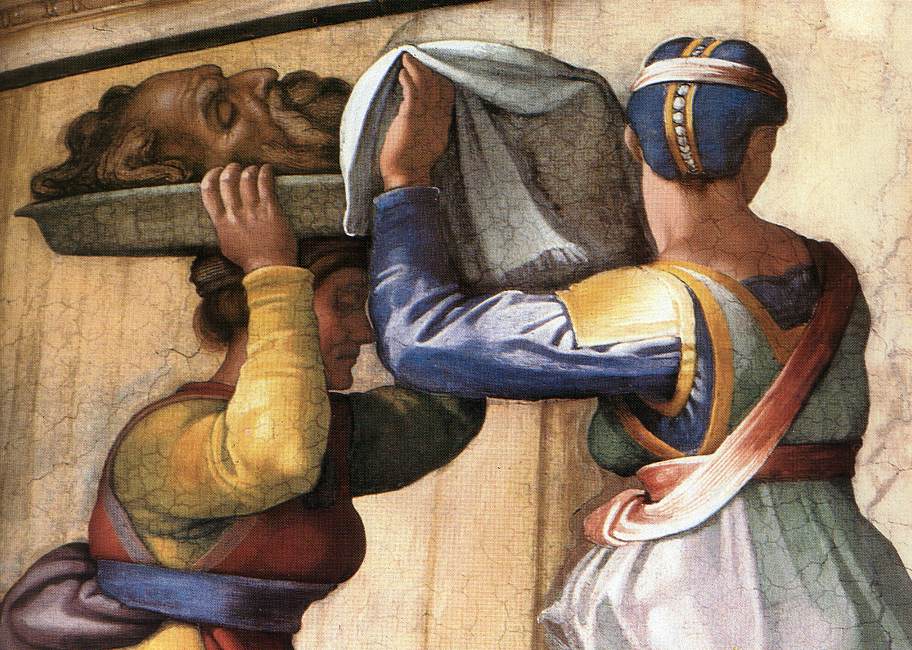
Michelangelo. Judith and Holofernes. 1508-1512
This is a piece of Michelangelo's ceiling. On the top portion, on the sides were many triangular portions for saints, and prophets. This composition is important because the subject of Judith and Holofernes is somewhat popular. and his piece is very nice. His composition for this piece is somewhat strange. Holofernes' tent seems to be made out of concrete, and the guard seems to be a tomato. Also, we see the faces of both Holofernes and Judith's maid, but we do not see the face of Judith. This is because she is looking back at the headless body of Holofernes, which could be construed as a semblance of remorse. The head of Holofernes seems to be remarkably large in comparison to both his own body, and the bodies of Judith and her maid. Which could be a symbol of the weight of their actions, and/or the difference in power of men and women in that time, to make Judith's act even braver.
The image “http://www.rense.com/general86/chapel.jpg” cannot be displayed, because it contains errors.
Michelangelo. Sistine Chapel Ceiling. 1508-1512.
This shows the majority of the work done by Michelangelo in the Sistine Chapel. in the very center is the creation of earth, humans, and sin. On the sides are various saints and disciples. At the end of the chapel is a painting of the end of days. This piece is very important because it was a huge undertaking for Michelangelo (who was also working on the tomb for the pope at the time) however it only took him 4 years, despite working alone for the most part. This is also important because for this task Michelangelo created scaffolding which could allow him to reach these heights. Michelangelo created more than 300 figures for this project.
Michelangelo. The Creation of the Sun and the Moon. Sistine Chapel. 1508-1512
This piece of Michelangelo's Sistine Ceiling is god creating the sun and the moon. He is creating them at the same time, as it is written, but not taken literally. One interesting thing to note, besides the strange but very powerful stance of Michelangelo's god, is the angel's in the background cringing and crying, and god's very stern face.
http://senseinart.27eweb.net/assets/media.Image/1/GodLightDark.jpg
Michelangelo. God dividing the Light from the Darkness. Sistine Chapel. 1508-1512
This is also from the Sistine Ceiling paintings of Michelangelo. This shows the 7 days of creation from the perspective of one of the angels watching God work. This particular piece is God separating the light from the darkness. It is interesting to note that Michelangelo's god is very humanistic, and very very masculine, but very graceful in his fluid motions to create the world. God seems to be dancing, twisting and turning to create his masterpiece, much like Michelangelo was in creating his ceiling.
http://freechristimages.org/Images_Genesis/Adam_and_Eve_in_Garden_Michelangelo.jpg
Michelangelo. Adam and Eve in the Garden with the serpent. Renaissance (1508-1512)
This piece is at the front of Michelangelo's Sistine Chapel project. This composition points out Michelangelo's tendency in the chapel paintings to show women as very masculine. Also, the question of the serpent and what it looked like is brought into play. The serpent in this image seems to be a man/woman/snake. This composition is also interesting in that it shows Adam as cognizant of the origin of the fruit before he ate it. It shows the serpent handing the fruit to Eve, while Adam points towards the heavens in a sort of pleading motion for her or the serpent to stop.
http://rjdent.files.wordpress.com/2009/09/tgoed-hb-tryptych.jpg
Hieronymous Bosch. The garden of Earthly Delights triptych. Netherlands. 1504.
This piece is a triptych which means the two small side portions close, revealing the beginning of the creation story, the creation of the earth. when you open the doors and read the story from left to right we see God in the garden of eden with Adam and Eve. The next portion is the earth in its present state, with sin and gluttony running amuck. The last portion is of the end of times, and the punishment for the way the people in the last portion were acting. This piece is important because it is a clear representation of Bosch's work. He did a few triptychs and used biblical themes and journeys of life throughout his lifetime. Also, he used many strange monsters in this work, as well as the rest of his work. The Adam and Eve portion is unique in that it shows the garden of eden in peace, but we can see a cat eating a mouse, which differs from Duer's engraving of the events. This symbol could mean many things, including that evil may have existed from creation, and was characteristic of animals (such as the cat, and the serpent) that the humans adopted. The other strange things in this painting include the weird crab thing in the middle of the composition, and the fact that strange beings are crawling from the hole in the bottom of the composition. This hole could be a lake, or perhaps a link to the world of the third painting, which would explain the evil preexisting original sin.
http://www.csa.com/discoveryguides/envrel/images/eden.jpg
Albrecht Duer. Adam and Eve. Germany. 1504.
This piece is an engraving of the story of Adam and Eve. This is before the eating of the forbidden fruit and shows the peacefulness of the garden of eden. Unlike the Bosch piece, all of the animals are at peace with one another, such as the cat and mouse which sit looking at one another. Also the ox in the background is at rest, despite its reputation of being a very angry, violent creature. We see, however, the serpent handing Eve the fruit, as if this is seconds before original sin. This piece is very interesting in that things become evident after looking at it for a few moments, such as the ox and the block at the top right which was the calling card for the artist.
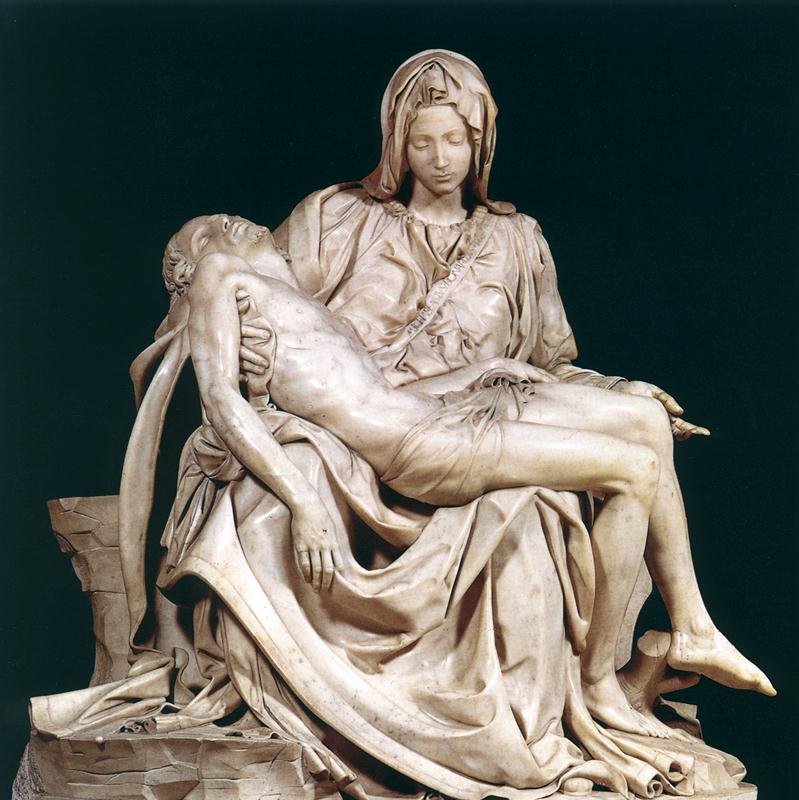
http://www.bluffton.edu/~sullivanm/belgium/bruges/michelangelo/pieta.jpg
Michelangelo. Pieta. 1499.
The Pieta is a very important work by Michelangelo. It is placed in St. Peter's Basilica within the walls of the vatican city. The pyramid shape of the work is interesting to ponder, drawing the attention away from the dying Jesus and towards the face of his mother (who appears to be very young, perhaps in homage to her virginity?) Lazlo Toth destroyed part of this statue in the 1970s by coming at it with a hammer, ruining part of Mary's face (her nose is still missing) and breaking off part of her hand.
http://d1shzm2uca9f83.cloudfront.net/large/masaccio_verdrijving.jpg
Massaccio. Adam and Eve Expelled from Paradise. Early Renaissance (1424-1425)
This piece is interesting because it was done in fresco, and we can see the different patches of the artists work. Also, the fact that Eve strives to cover herself in her shame while Adam just covers his face is an interesting question to ponder. Did the artist mean to say that the female race is more shameful of their bodies, while the men are more ashamed of their actions?
The Fall of Adam and Eve, Hugo van der Goes 1470 royalty free images
Hugo van der Goes. The fall of Adam and Eve. Netherlands. Renaissance (1470)
This piece is interesting because it explores the question of what the serpent really looked like (such as in Michelangelo's portrayl.) It is interesting to notice the background images of eden seem to already be decaying. Also the convenient placement of Adam's hand and the orchid, can not be over looked.
http://media-2.web.britannica.com/eb-media/91/3991-050-975C7807.jpg
Bishop Bernward. Adam and Eve cast out. Germany. 1000ce.
This is a door on a cathedral in Germany. This work, like the bayeux tapestry is a series of images made to tell a story. This portion of the story is telling the story of Adam and Eve passing the blame of eating the forbidden fruit. God points at Adam, who points at Eve, who points at the serpent. This is important because it is unusual to see this part of the story portrayed.
http://healigan08-09.wikispaces.com/file/view/Bayeux%2520tapestry%2520-%2520Harold.jpg/41835855/Bayeux%2520tapestry%2520-%2520Harold.jpg
Bayeux Tapestry, England VS. France. 1070ce
This "tapestry" chronicles the events preceding and including the Battle of Hastings. This is important because it shows a beginning to comic books and things of that type. It is disputed over whether it belongs to France or to England, as both were featured in the tapestry on either side of the conflict.
[Christ.jpg]
Christ as conquering Roman Hero, Ravenna Italy, Byzantine mosaic
This portrayl of Jesus is very typical in stamping on the snake, as well as halo, and cross. It is, however an unusual portrayl of Jesus in that he is in a Roman uniform, and is in a quite powerful stance. The fact that is a Byzantine piece is evident in the mosaic form, as well as that it has Jesus as the subject holding the book and with the halo surrounding his head. However most other Jesus mosaics show him in a peaceful stance.